Selected research insights
Which professional information channels doctors use
The study shows that today doctors do not rely on a single channel for obtaining professional information. Instead, they create their own combination of sources depending on the task and situation. Medical websites (96%) and educational platforms (95%) have the highest reach — in fact, almost every doctor uses them. At the same time, a significant share of the audience receives professional information via Viber (74%), medical information systems (67%), mobile applications (64%) and YouTube (62%).
AI: from an additional tool to one of the sources of professional information
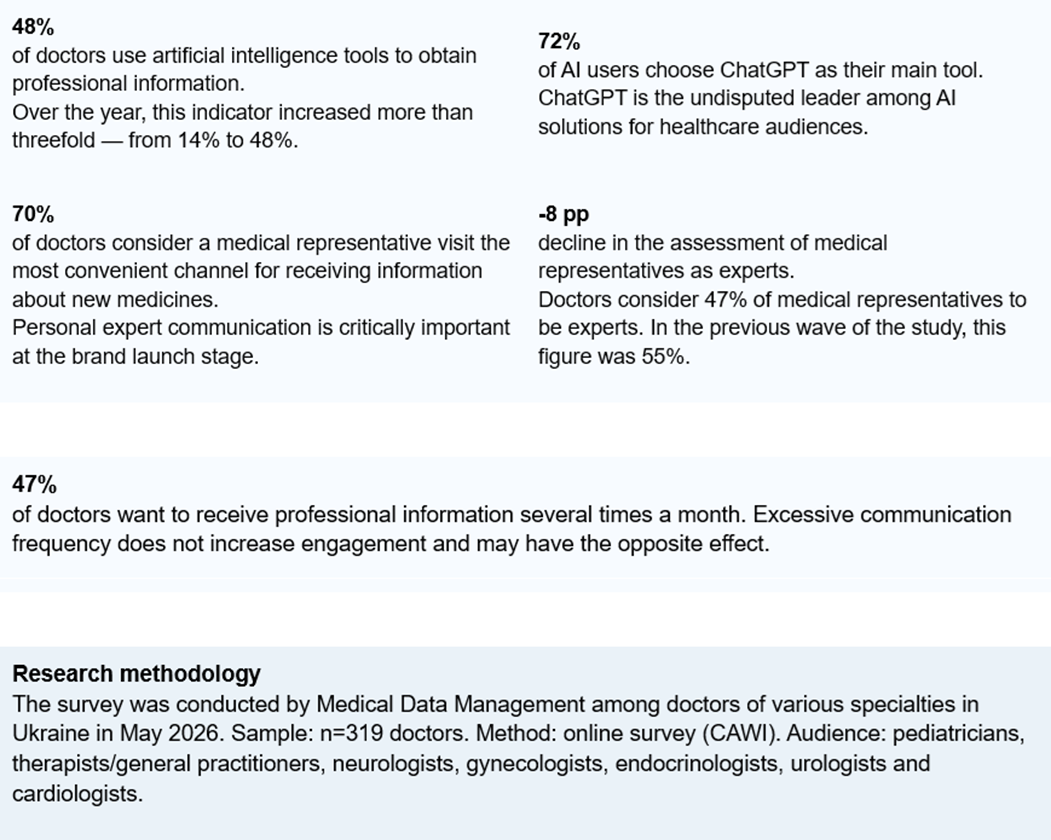
The growing use of artificial intelligence has become one of the most notable findings of the study. While in 2025 only 14% of doctors reported using AI to obtain professional information, in 2026 this indicator reached 48%. Thus, artificial intelligence tools are already used by almost half of the surveyed doctors.
Among doctors who use AI, ChatGPT is the clear leader: 72% of respondents named it their main tool. By comparison, 49% use Gemini and 7% use Copilot.
The medical representative remains a key figure in professional communication
Despite the development of digital channels, visits by medical representatives remain the highest-priority channel for receiving information about medicines. They were selected as the first priority by 41% of doctors, while educational platforms received 35%, and messengers and chatbots received 19%.
At the same time, the study shows high expectations for the quality of this interaction. For 73% of doctors, a key indicator of a medical representative’s professionalism is in-depth knowledge of the medicine, dosage and treatment regimens. For 57%, the ability to conduct a professional dialogue is important, and for 45%, consultations on drug interactions are important.
Interestingly, doctors consider only 47% of medical representatives to be experts. In the previous wave of the study, this figure was 55%. Potentially, the decline in this indicator may point to a worsening staffing crisis, which creates a need to hire employees without prior experience and/or medical education, leading to a loss of professionalism.
In this context, it is logical that remote visits continue to hold significant positions in doctors’ preferences. In conditions of staff shortages and in regions close to combat zones, they can serve as a full-fledged alternative for communication with doctors.
A new medicine or a well-known brand: doctors choose different channels
The study results indicate that the choice of communication channel depends on the type of medicine being discussed. For new medicines, the most important sources of information remain medical representatives (70%) and online educational platforms (62%). Doctors more often prefer channels that allow them to receive more detailed information and ask additional questions. For long-established medicines, the preference structure looks different. Digital tools come first — educational platforms (56%) and messengers with chatbots (53%), while medical representative visits were chosen by 51% of respondents. Remote visits remain a stable channel for receiving information for both new and well-known brands.
These results demonstrate that different channels perform different functions in the process of obtaining professional information.
What the communication format should be
A practical outcome of the study was the determination of the preferred communication frequency. Almost half of doctors (47%) would like to receive professional information several times a month, while only 5% chose daily communication. Excessive communication frequency does not increase engagement and may have the opposite effect.
Conclusions
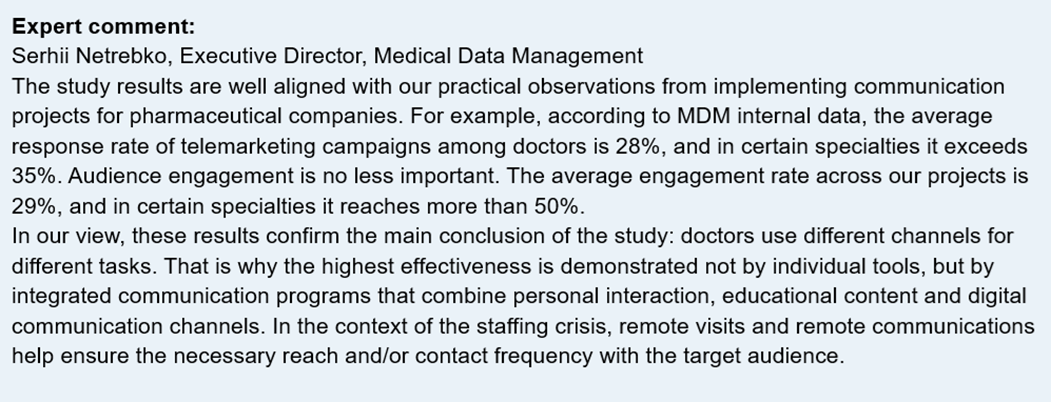
The study shows that doctors’ professional information behavior is becoming increasingly multichannel. Medical websites, educational platforms, messengers, medical information systems and rapidly growing artificial intelligence tools are used in parallel, with each channel performing its own function in the process of obtaining professional information.